Vairotsana Contents Disciples Translations Travels Publications Notes References Navigation menuExcerpt Chapter"Eye of the Storm"The Great Image: The Life Story of Vairochana, the Translatorecb143908140(data)1317211860000 0003 8244 7115n90675939jo201689928911864484X265187844265187844
Buddhist philosophersDzogchenLamasNyingmaNyingmapa BuddhistsTranslators to TibetanTranslators from Sanskrit8th-century translators
WylielotsawaTrisong DetsenPadmasambhavapanditaŚāntarakṣitaŚrī SiṅghasemdelongdeDzogchenTibetVimalamitratrul khorShechen GyaltsabvidyadharasGarab DorjeMañjuśrīmitraVairocanadhyani BuddhaYudra NyingpoJnana Kumara of NyagPang Gen Mipham Gönporainbow bodyDzogchen LongdeTsele Natsok RangdrölJamgon KongtrulTrisong DetsenDharmapanditasKhotanNepalZhangzhungMoheyan
This article is about the Tibetan translator. For the primordial Buddha Vairocana, please see Vairocana
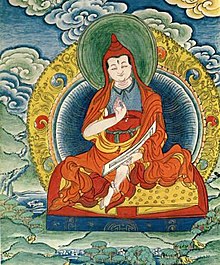
Vairotsana (Wylie: ba gor bai ro tsa na) was a lotsawa or "translator" living during the reign of King Trisong Detsen, who ruled 755-97 CE. Vairotsana, one of the 25 main disciples of Padmasambhava, was recognized by the latter as a reincarnation of an Indian pandita. He was among the first seven monks ordained by Śāntarakṣita, and was sent to Dhahena in India to study with Śrī Siṅgha, who taught him in complete secrecy. Śrī Siṅgha in turn entrusted Vairotsana with the task of propagating the semde and longde sections of Dzogchen in Tibet. He is one of the three main masters to bring the Dzogchen teachings to Tibet, the two others being Padmasambhava and Vimalamitra, and was also a significant lineage holder of trul khor.
Shechen Gyaltsab mentions in his Pond of White Lotus Flowers that before meeting Śrī Siṅgha, Vairotsana had met the wisdom forms of the two vidyadharas Garab Dorje and Mañjuśrīmitra in a miraculous pagoda at Dhahena. After he had presented a huge offering of gold, they conferred empowerment upon him and bestowed their blessings, with the prediction that he would receive the complete teachings from Shri Singha.
He is named after Vairocana, the central dhyani Buddha.
Contents
1 Disciples
2 Translations
3 Travels
4 Publications
5 Notes
6 References
6.1 Electronic
6.2 Print
Disciples
Vairotsana's chief disciples were Yudra Nyingpo, Sangtön Yeshe Lama, Pang Gen Sangye Gönpo, Jnana Kumara of Nyag (Wylie: nyag ye she gzhon nu), and Lady Yeshe Drönma (Wylie: jo mo ye shes sgron). An especially renowned disciple was the old Pang Gen Mipham Gönpo whose disciples attained the rainbow body for seven generations by means of the oral instructions of Dzogchen Longde entitled 'Dorje Zampa' (Wylie: rdo rje zam pa) also known as the 'Vajra Bridge'. Tsele Natsok Rangdröl, Terdag Lingpa Gyurmey Dorje, and Jamgon Kongtrul are regarded as reincarnations of Vairotsana.
Translations
Travels
Born in Pagor,[a] Vairotsana was sent to India by Trisong Detsen to learn the Dharma with Indian panditas. Vairotsana also travelled widely in China, Khotan, Nepal, Zhangzhung, amongst other places. Vairotsana also went to China and received teachings from nineteen teachers. Amongst these were: Kusula Bhitigarbha, Dharmabodhi, Vajra Sukha Deva, Pandita Barma, Tsenda Ritropa, Mahabodhi, Shri Ani, Moheyan, Surya Ghirti and Satipa.[2]
Publications
- Eye of the Storm: Vairotsana's Five Original Transmissions (Snga 'gyur lnga)—translation and commentary by Keith Dowman; Vajra Publications, Nepal.[3]
Notes
^ Another source says Vairotsana was born in Nyêmo Chekar near Uyuk in Nyêmo County.[1]
^ Yudra Nyingpo 2004, p. 346.
^ Zenkar, Ala (1998). "Introduction: A Summary of the Text" in: Palmo, Ani Jima (Eugenie de Jong; translator); Nyingpo, Yudra (compilor, et al.) (2004). The Great Image: the Life Story of Vairochana the translator. Shambala Publications, Inc.: Boston, Massachusetts, U.S.A. .mw-parser-output cite.citationfont-style:inherit.mw-parser-output .citation qquotes:"""""""'""'".mw-parser-output .citation .cs1-lock-free abackground:url("//upload.wikimedia.org/wikipedia/commons/thumb/6/65/Lock-green.svg/9px-Lock-green.svg.png")no-repeat;background-position:right .1em center.mw-parser-output .citation .cs1-lock-limited a,.mw-parser-output .citation .cs1-lock-registration abackground:url("//upload.wikimedia.org/wikipedia/commons/thumb/d/d6/Lock-gray-alt-2.svg/9px-Lock-gray-alt-2.svg.png")no-repeat;background-position:right .1em center.mw-parser-output .citation .cs1-lock-subscription abackground:url("//upload.wikimedia.org/wikipedia/commons/thumb/a/aa/Lock-red-alt-2.svg/9px-Lock-red-alt-2.svg.png")no-repeat;background-position:right .1em center.mw-parser-output .cs1-subscription,.mw-parser-output .cs1-registrationcolor:#555.mw-parser-output .cs1-subscription span,.mw-parser-output .cs1-registration spanborder-bottom:1px dotted;cursor:help.mw-parser-output .cs1-ws-icon abackground:url("//upload.wikimedia.org/wikipedia/commons/thumb/4/4c/Wikisource-logo.svg/12px-Wikisource-logo.svg.png")no-repeat;background-position:right .1em center.mw-parser-output code.cs1-codecolor:inherit;background:inherit;border:inherit;padding:inherit.mw-parser-output .cs1-hidden-errordisplay:none;font-size:100%.mw-parser-output .cs1-visible-errorfont-size:100%.mw-parser-output .cs1-maintdisplay:none;color:#33aa33;margin-left:0.3em.mw-parser-output .cs1-subscription,.mw-parser-output .cs1-registration,.mw-parser-output .cs1-formatfont-size:95%.mw-parser-output .cs1-kern-left,.mw-parser-output .cs1-kern-wl-leftpadding-left:0.2em.mw-parser-output .cs1-kern-right,.mw-parser-output .cs1-kern-wl-rightpadding-right:0.2em
ISBN 1-59030-069-6 (pbk.: alk. paper). p.xxviii, Excerpt Chapter
^ Eye of the Storm.
References
Electronic
"Eye of the Storm". Keith Dowman. Retrieved 2015-02-21.- Schaeffer, Kurtis R. (2000). "The Religious Career of Vairocanavajra - a Twelfth-Century Indian Buddhist Master from Dakṣiṇa Kośala" in Journal of Indian Philosophy; vol. 28: pp. 361–384. Netherlands: Kluwer Academic Publishers. Source: [1] (accessed: September 14, 2008)
Print
- The Nyingma School of Tibetan Buddhism; HH Dudjom Rinpoche, ed. and trans. by Gyurme Dorje and Matthew Kapstein; Wisdom Publications, 1991
Yudra Nyingpo (2004). The Great Image: The Life Story of Vairochana, the Translator. Translated by Eugenie de Jong (Ani Jinba Palmo). Boston, Massachusetts: Shambhala Publications. ISBN 978-1-59030-069-5.
Topics in Buddhism | |
|---|---|
| *_Index *_Outline|16x16px|link="_Outline">
| |
| Foundations |
|
| The Buddha |
|
| Bodhisattvas |
|
| Disciples |
|
| Key concepts |
|
| Cosmology |
|
| Branches |
|
| Practices |
|
| Nirvana |
|
| Monasticism |
|
| Major figures |
|
| Texts |
|
| Countries |
|
| History |
|
| Philosophy |
|
| Culture |
|
| Miscellaneous |
|
| Comparison |
|
| Lists |
|
| |
 Outline
 Category
 Portal
Authority control  |
|
|---|
8th-century translators, Buddhist philosophers, Dzogchen, Lamas, Nyingma, Nyingmapa Buddhists, Translators from Sanskrit, Translators to TibetanUncategorized


