Pygmy cormorant Contents Distribution Habitat and ecology Threats Bibliography References External links Navigation menu"Microcarbo pygmaeus""Microcarbo pygmaeus Species Distribution Map""Robert Ritter von Dombrowski, ornithologist"the original"Situation of Pygmy Cormorant Population in Europe""Data concerning diet and nesting of Pygmy Cormorant (Phalacrocorax pygmeus) in the Danube Delta""African-Eurasian Waterbird Agreement AEWA"BirdLife species factsheet for Microcarbo pygmaeus"Microcarbo pygmaeus""Pygmy cormorant media"Pygmy cormorant photo galleryInteractive range map of Microcarbo pygmaeusIUCN Red List mapsAudio recordings of Pygmy cormorantePhalacrocorax_pygmeusAFF49475BDB69B4E22696734microcarbo-pygmaeuspygcor243749766066518pygmy-cormorant-phalacrocorax-pygmaeus50824882400022696734413946Microcarbo-pygmaeus
Magnificent frigatebirdAscension frigatebirdChristmas Island frigatebirdGreat frigatebirdLesser frigatebirdBlue-footed boobyPeruvian boobyMasked boobyNazca boobyRed-footed boobyBrown boobyTasman boobyAbbott's boobyNorthern gannetCape gannetAustralasian gannetAnhingaOriental darterAfrican darterAustralasian darterDouble-crested cormorantNeotropic cormorantLittle black cormorantGreat cormorantWhite-breasted cormorantIndian cormorantCape cormorantSocotra cormorantBank cormorantJapanese cormorantEuropean shagBrandt's cormorantSpectacled cormorantPelagic cormorantRed-faced cormorantRock shagGuanay cormorantPied cormorantBlack-faced cormorantRough-faced shagFoveaux shagOtago shagChatham shagAuckland shagCampbell shagBounty shagImperial shagHeard Island shagCrozet shagAntarctic shagKerguelen shagMacquarie shagSouth Georgia shagRed-legged cormorantSpotted shagPitt shagLittle pied cormorantLong-tailed cormorantCrowned cormorantLittle cormorantPygmy cormorantFlightless cormorant
IUCN Red List least concern speciesMicrocarboBirds of EuropeBirds of Central AsiaBirds of Western AsiaBirds described in 1773
cormorantseabirdsEuropeAsiamigratorywestern EuropeKazakhstanTajikistanTurkmenistanUzbekistanAlbaniaGreeceBulgariaRomaniaTurkeyCyprusIranIraqAzerbaijanIsraelSyriaDanube DeltaConstanța CountyMunteniaGreat Brăila IslandIasi CountyGalați CountyVaslui CountyGalați CountyCaraș-Severin CountyTulcea CountyRomanianestshabitatsInternational Union for Conservation of NatureRed ListAEWA
| Pygmy cormorant | |
|---|---|
 | |
Conservation status | |
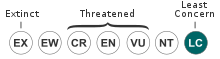 Least Concern (IUCN 3.1)[1] | |
Scientific classification  | |
| Kingdom: | Animalia |
| Phylum: | Chordata |
| Class: | Aves |
| Order: | Suliformes |
| Family: | Phalacrocoracidae |
| Genus: | Microcarbo |
| Species: | M. pygmaeus |
Binomial name | |
Microcarbo pygmaeus (Pallas, 1773) | |
 | |
| Range of M. pygmaeus Breeding Resident Non-breeding Vagrant (seasonality uncertain) | |
Synonyms | |
Phalacrocorax pygmeus | |
The pygmy cormorant (Microcarbo pygmaeus) is a member of the Phalacrocoracidae (cormorant) family of seabirds. It breeds in south-eastern Europe and south-western Asia. It is partially migratory, with northern populations wintering further south, mostly within its breeding range. It is a rare migrant to western Europe.
Contents
1 Distribution
2 Habitat and ecology
3 Threats
4 Bibliography
5 References
6 External links
Distribution
The pygmy cormorant occupies an area from the south-east of Europe (east of Italy) and south-west of Asia, east to Kazakhstan, Tajikistan, Turkmenistan, and Uzbekistan.[2] The largest distribution is in south-east Europe, Albania, Greece, Bulgaria, Romania, the Balkan countries, Turkey, Cyprus, Iran, Iraq, Azerbaijan, Israel, Syria. In Romania, according to studies of Czech ornithologist Robert Ritter von Dombrowski,[3] at the end of the 19th century, the pygmy cormorant was present in large colonies in the Danube Delta, Brăila and Ialomița Pond, on Vederoasa Lake (Constanța County), on certain pools and ponds with reeds and willows in Muntenia. The number of pygmy cormorant pairs was 10,000 without taking in account the breeding population of the Danube Delta. Populations of pygmy cormorant in Romania have dramatically declined, especially in 1960 when, due to the communist agricultural policies, the Great Brăila Island and important parts of Ialomiţa Pond were drained in order to practice agriculture, so the habitats of a great number of aquatic birds were destroyed. The pygmy cormorant can be found in the Danube Delta, Jijia Largă Pond (Iasi County), probably on Maţa, Rădeanu, Vădeni Ponds (in Galați County), Cârja Pond (Vaslui County), at Vlădeşti on Prut River (Galați County), on Calinovăţ Island from Caraș-Severin County, on Small Brăila Island, on Dunăreni Pond (Mârleanu, Constanța County), in Danubian Plain on Parches Pond-Somova (Tulcea County). At the global scale, it was estimated that the entire population of pygmy cormorants is 85,000-180,000 individuals (a study effectuated by Wetlands International in 2006) and 74-94% of total population lives in Europe. The biggest colony is in the Danube Delta, numbering 4,000 pairs, but this seems certain to plunge due to a massive canalization scheme, which despite the protected status of the delta, commenced in May 2004. According to a study made by BirdLife International in 2004,[4] it was estimated that population of pygmy cormorant in Romania was 11,500-14,000 pairs and during the winter 1,500-4,000 pairs.
Habitat and ecology

Pygmy cormorants and little egret (Egretta garzetta) in the Venetian Lagoon

Egg, Collection Museum Wiesbaden
Pygmy cormorants like pools with plenty of vegetation, lakes and river deltas. They avoid mountainous and cold and dry areas. They love rice fields or other flooded areas where trees and shrubs can be found. During winter they also go to waters with higher salinity, in estuaries or on barrier lakes. These are birds who can live alone or in groups and they have adapted to human presence. They build nests from sticks and reeds in dense vegetation, in trees, shrubs, willows but occasionally in reeds on small floating islets. At the end of May, beginning of June, both parents incubate for 27–30 days, and nestlings become independent after 70 days. The young are fed by their parents with small fish and other aquatic animals.[5] This bird frequently shares the same type of habitat with egrets, herons and spoonbills.
Threats
The pygmy cormorant is a species with habitats strongly affected by human actions. Threats include the drainage and serious degradation of wetlands and their associated woodland, water pollution, disturbance, and poaching as well as drowning in fishing nets.
Being a great fish consumer and destroyer of fishing nets, it is often persecuted by fishermen. In Romania, pond drainage located on the inferior course of the Danube for agricultural purposes, the accidental death of birds captive in improvised fishing nets, nest destruction by professional fishermen in order to protect fish resources decreased of the number of individuals which put the species on the International Union for Conservation of Nature (IUCN) Red List as a vulnerable species. It is also hunted in leisure activities, and in Iran the pygmy cormorant is commercialized for cooking.
This species is distinguished from the great cormorant and the common shag by its much smaller size, lighter build, and long tail.
It feeds mainly on fish, often hunting in groups, and perches in trees between fishing expeditions.
The pygmy cormorant is one of the species to which the Agreement on the Conservation of African-Eurasian Migratory Waterbirds (AEWA) applies.[6]
Bibliography
Nelson, J. Brian (2006). Pelicans, Cormorants, and Their Relatives: The Pelecaniformes. Bird Families of the World. Oxford University Press. ISBN 978-0-19-857727-0..mw-parser-output cite.citationfont-style:inherit.mw-parser-output .citation qquotes:"""""""'""'".mw-parser-output .citation .cs1-lock-free abackground:url("//upload.wikimedia.org/wikipedia/commons/thumb/6/65/Lock-green.svg/9px-Lock-green.svg.png")no-repeat;background-position:right .1em center.mw-parser-output .citation .cs1-lock-limited a,.mw-parser-output .citation .cs1-lock-registration abackground:url("//upload.wikimedia.org/wikipedia/commons/thumb/d/d6/Lock-gray-alt-2.svg/9px-Lock-gray-alt-2.svg.png")no-repeat;background-position:right .1em center.mw-parser-output .citation .cs1-lock-subscription abackground:url("//upload.wikimedia.org/wikipedia/commons/thumb/a/aa/Lock-red-alt-2.svg/9px-Lock-red-alt-2.svg.png")no-repeat;background-position:right .1em center.mw-parser-output .cs1-subscription,.mw-parser-output .cs1-registrationcolor:#555.mw-parser-output .cs1-subscription span,.mw-parser-output .cs1-registration spanborder-bottom:1px dotted;cursor:help.mw-parser-output .cs1-ws-icon abackground:url("//upload.wikimedia.org/wikipedia/commons/thumb/4/4c/Wikisource-logo.svg/12px-Wikisource-logo.svg.png")no-repeat;background-position:right .1em center.mw-parser-output code.cs1-codecolor:inherit;background:inherit;border:inherit;padding:inherit.mw-parser-output .cs1-hidden-errordisplay:none;font-size:100%.mw-parser-output .cs1-visible-errorfont-size:100%.mw-parser-output .cs1-maintdisplay:none;color:#33aa33;margin-left:0.3em.mw-parser-output .cs1-subscription,.mw-parser-output .cs1-registration,.mw-parser-output .cs1-formatfont-size:95%.mw-parser-output .cs1-kern-left,.mw-parser-output .cs1-kern-wl-leftpadding-left:0.2em.mw-parser-output .cs1-kern-right,.mw-parser-output .cs1-kern-wl-rightpadding-right:0.2em
Hume, Rob (2011). RSPB Birds of Britain and Europe (3rd (+CD) ed.). Dorling Kindersley. ISBN 978-1405362023.
References
^ BirdLife International (2012). "Microcarbo pygmaeus". IUCN Red List of Threatened Species. Version 2014.3. International Union for Conservation of Nature. Retrieved 3 June 2018.
^ "Microcarbo pygmaeus Species Distribution Map". The IUCN Red List of Threatened Species.
^ "Robert Ritter von Dombrowski, ornithologist". Archived from the original on 2014-07-14. Retrieved 2019-02-07.
^ "Situation of Pygmy Cormorant Population in Europe" (PDF).
^ Kiss, J. Botond; Rekasi, Jozsef. "Data concerning diet and nesting of Pygmy Cormorant (Phalacrocorax pygmeus) in the Danube Delta" (PDF). Anale Ştiinţifice ale Institutului de Cercetare Dezvoltare Delta Dunării 2000-2001 [Scientific Annals of the Danube Delta Institute for Research & Development 2000-2001]. Editura Tehnică. 8.
^ "African-Eurasian Waterbird Agreement AEWA".
External links
 | Wikimedia Commons has media related to Microcarbo pygmeus. |
 | Wikispecies has information related to Microcarbo pygmaeus |
- BirdLife species factsheet for Microcarbo pygmaeus
"Microcarbo pygmaeus". Avibase.
"Pygmy cormorant media". Internet Bird Collection.
Pygmy cormorant photo gallery at VIREO (Drexel University)
Interactive range map of Microcarbo pygmaeus at IUCN Red List maps
Audio recordings of Pygmy cormorant on Xeno-canto.

Birds described in 1773, Birds of Central Asia, Birds of Europe, Birds of Western Asia, IUCN Red List least concern species, MicrocarboUncategorized


