Octahedral cupola Contents Related polytopes See also References External links Navigation menuConvex SegmentochoraSegmentochora:oct || sirco, K-4.107expanding ite
PolychoraPolychora stubs
geometry4-polytopeoctahedronrhombicuboctahedrontriangular prismssquare pyramidsruncinated 24-cell
| Octahedral cupola | ||
|---|---|---|
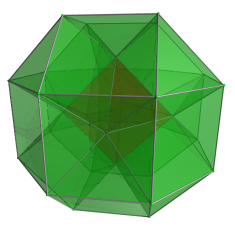 Schlegel diagram | ||
| Type | Polyhedral cupola | |
Schläfli symbol | 3,4 v rr3,4 | |
| Cells | 28 | 1 3,4  1 rr4,3  8+12 ×3  6 v4  |
| Faces | 82 | 40 triangles 42 squares |
| Edges | 84 | |
| Vertices | 30 | |
| Dual | ||
Symmetry group | [4,3,1], order 48 | |
| Properties | convex, regular-faced | |
In 4-dimensional geometry, the octahedral cupola is a 4-polytope bounded by one octahedron and a parallel rhombicuboctahedron, connected by 20 triangular prisms, and 6 square pyramids.[1]
Contents
1 Related polytopes
2 See also
3 References
4 External links
Related polytopes
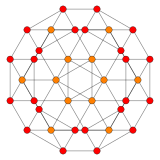
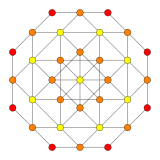
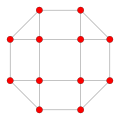
The octahedral cupola can be sliced off from a runcinated 24-cell, on a hyperplane parallel to an octahedral cell. The cupola can be seen in a B2 and B3 Coxeter plane orthogonal projection of the runcinated 24-cell:
| Runcinated 24-cell | Octahedron (cupola top) | Rhombicuboctahedron (cupola base) |
|---|---|---|
| B3 Coxeter plane | ||
 |  |  |
| B2 Coxeter plane | ||
 |  |  |
See also
- Octahedral pyramid
- Cubic cupola
- Runcinated 24-cell
References
^ Convex Segmentochora Dr. Richard Klitzing, Symmetry: Culture and Science, Vol. 11, Nos. 1-4, 139-181, 2000 (4.107 octahedron || rhombicuboctahedron)
External links
Segmentochora: oct || sirco, K-4.107
 | This 4-polytope article is a stub. You can help Wikipedia by expanding it. |
Polychora, Polychora stubsUncategorized


