Languages of Papua New Guinea Contents English Tok Pisin Hiri Motu Unserdeutsch Papuan languages Austronesian languages Literacy Notes References Navigation menuStatement at the World Leaders ForumArchived"Seven decades after Independence, many small languages in India face extinction threat""Papua New Guinea's incredible linguistic diversity"Papua New Guinea"Documenting Unserdeutsch Reversing Colonial Amneasia"eee
EnglishHiri MotuTok PisinPapua New Guinean Sign LanguageAkoyeAngaatahaAnkaveHamtaiKamasaKawachaMenyaSafeyokaSimbariSusuamiTainaeYagwoiaYipmaAwinPaBarugaBinandereEwageKorafeOrokaivaSuenaYekoraZiaAimeleBeamiEdoloKaluliKasuaOnobasuluSoniaChuaveDomGolinKandawoKaugelKumanMaringMelpaNarakNiiNomaneSalt-YuiSinasinaTembaglaWahgiBilurFanamaketKandasKonomalaKuanuaLabelNiwer MilPatpatarRamoaainaSiarSursurungaWarwar FeniDunaPogayaFasuFiwagaFoiFembeGobasiKonaiKuboOdoodeeSamoAngalBisorioEngaHuliIpiliKewaKyakaLembenaSamberigiKaki AeKeoruOpaoOrokoloToaripiTairumaBiminFaiwolMianNgalumNinggerumOksapminSetamanSugangaTelefolTifalUrapYonggomDadibiFolopaAbomBaramuBiturTirioWereIkobiOmatiRumuFinisterre–HuonKainantu–GorokaMadangRamu–Lower SepikSepikSoutheast PapuanTorricelliAustraliaFederated States of MicronesiaFijiKiribatiMarshall IslandsNauruNew ZealandPalauPapua New GuineaSamoaSolomon IslandsTongaTuvaluVanuatuAmerican SamoaChristmas IslandCocos (Keeling) IslandsEaster IslandFrench PolynesiaGuamHawaiiNew CaledoniaNorfolk IslandNorthern Mariana IslandsPitcairn IslandsTokelauWallis and Futuna
Languages of Papua New Guinea
Papua New GuineaIndonesiaSir Michael Somareofficial languagesTok PisinEnglishHiri MotuPapua New Guinean Sign Languagecreolelingua francaPapua New Guinean Sign LanguagedeafEnglishEnglishcreole languageWesternGulfCentralOroMilne BayMotu languageAustronesian language familyRabaulGermancreole languageEast New Britain ProvinceIndonesiaEast TimorSolomon IslandsAustronesian familyMalagasyMadagascarRapa NuiEaster IslandFormosan languagesTaiwanliterate
| Languages of Papua New Guinea | |
|---|---|
 | |
| Official | Tok Pisin, English, Hiri Motu, Papua New Guinean Sign Language |
| Lingua franca | Tok Pisin |
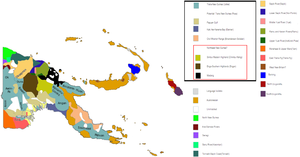
Today, the languages of Papua New Guinea number over 850. These languages are spoken by the inhabited tribal groups of Papua New Guinea and Indonesia. In 2006, Prime Minister Sir Michael Somare stated that "Papua New Guinea has 832 living languages (languages, not dialects)" [1] making it the most linguistically diverse place on earth.[2][3] Its official languages are Tok Pisin, English, Hiri Motu and Papua New Guinean Sign Language. Tok Pisin, an English-based creole, is the most widely spoken, serving as the country's lingua franca. Papua New Guinean Sign Language became the fourth official language in May 2015, and is used by the deaf population throughout the country.
Contents
1 English
2 Tok Pisin
3 Hiri Motu
4 Unserdeutsch
5 Papuan languages
6 Austronesian languages
7 Literacy
8 Notes
9 References
English
Although English is an official language of Papua New Guinea, it is only spoken by 1–2% of the population.[4]
Tok Pisin
Tok Pisin is an English-based creole language spoken throughout Papua New Guinea. It is an official language of Papua New Guinea and the most widely used language in the country. In parts of Western, Gulf, Central, Oro and Milne Bay provinces, however, the use of Tok Pisin has a shorter history, and is less universal, especially among older people.
Hiri Motu
Hiri Motu, also known as Police Motu, Pidgin Motu, or just Hiri, is a simplified version of the Motu language, of the Austronesian language family.
Unserdeutsch
Unserdeutsch, or Rabaul Creole German, is a German-based creole language spoken mainly in East New Britain Province. It is the only creole language that has developed from colonial German. The lexicon is derived from German, while the substrate language is Tok Pisin. [5]
Papuan languages

The Trans-New Guinea family according to Malcolm Ross
Outside Papua New Guinea, Papuan languages are also spoken in Indonesia, East Timor, and the Solomon Islands.
Austronesian languages
People speaking languages belonging to the Austronesian family arrived in New Guinea approximately 3,500 years ago.[citation needed]
The Austronesian languages are widely spread across the globe, as far west as Malagasy in Madagascar, as far east as Rapa Nui on Easter Island, and as far as north as the Formosan languages of Taiwan. Austronesian has several primary branches, all but one of which are found exclusively on Taiwan.[citation needed]
Literacy
64.2% of the population of Papua New Guinea over 15 years of age are literate.[4]
Notes
^ (Statement at the World Leaders Forum Archived 2008-03-18 at the Wayback Machine, Columbia University, September 21, 2006; website of the Prime Minister of Papua New Guinea).
^ "Seven decades after Independence, many small languages in India face extinction threat"..mw-parser-output cite.citationfont-style:inherit.mw-parser-output .citation qquotes:"""""""'""'".mw-parser-output .citation .cs1-lock-free abackground:url("//upload.wikimedia.org/wikipedia/commons/thumb/6/65/Lock-green.svg/9px-Lock-green.svg.png")no-repeat;background-position:right .1em center.mw-parser-output .citation .cs1-lock-limited a,.mw-parser-output .citation .cs1-lock-registration abackground:url("//upload.wikimedia.org/wikipedia/commons/thumb/d/d6/Lock-gray-alt-2.svg/9px-Lock-gray-alt-2.svg.png")no-repeat;background-position:right .1em center.mw-parser-output .citation .cs1-lock-subscription abackground:url("//upload.wikimedia.org/wikipedia/commons/thumb/a/aa/Lock-red-alt-2.svg/9px-Lock-red-alt-2.svg.png")no-repeat;background-position:right .1em center.mw-parser-output .cs1-subscription,.mw-parser-output .cs1-registrationcolor:#555.mw-parser-output .cs1-subscription span,.mw-parser-output .cs1-registration spanborder-bottom:1px dotted;cursor:help.mw-parser-output .cs1-ws-icon abackground:url("//upload.wikimedia.org/wikipedia/commons/thumb/4/4c/Wikisource-logo.svg/12px-Wikisource-logo.svg.png")no-repeat;background-position:right .1em center.mw-parser-output code.cs1-codecolor:inherit;background:inherit;border:inherit;padding:inherit.mw-parser-output .cs1-hidden-errordisplay:none;font-size:100%.mw-parser-output .cs1-visible-errorfont-size:100%.mw-parser-output .cs1-maintdisplay:none;color:#33aa33;margin-left:0.3em.mw-parser-output .cs1-subscription,.mw-parser-output .cs1-registration,.mw-parser-output .cs1-formatfont-size:95%.mw-parser-output .cs1-kern-left,.mw-parser-output .cs1-kern-wl-leftpadding-left:0.2em.mw-parser-output .cs1-kern-right,.mw-parser-output .cs1-kern-wl-rightpadding-right:0.2em
^ A.V. (24 July 2017). "Papua New Guinea's incredible linguistic diversity". The Economist. Retrieved 20 July 2017.
^ ab CIA World Factbook: Papua New Guinea
^ Maitz, Volker, Peter, Craig Volker (2017). "Documenting Unserdeutsch Reversing Colonial Amneasia" (PDF). Journal of Pigin and Creole Languages: 365–397.
References
Gordon, Raymond G., Jr. (ed.) (2005). Ethnologue: Languages of the World (Fifteenth ed.). Dallas, Tex.: SIL International.CS1 maint: Multiple names: authors list (link) CS1 maint: Extra text: authors list (link)
 Languages of Papua New Guinea Languages of Papua New Guinea | |||||||||||||||||||||||||||||||||
|---|---|---|---|---|---|---|---|---|---|---|---|---|---|---|---|---|---|---|---|---|---|---|---|---|---|---|---|---|---|---|---|---|---|
| Official languages |
| ||||||||||||||||||||||||||||||||
| Major Indigenous languages |
| ||||||||||||||||||||||||||||||||
| Other Papuan languages |
| ||||||||||||||||||||||||||||||||


